
Eye movements
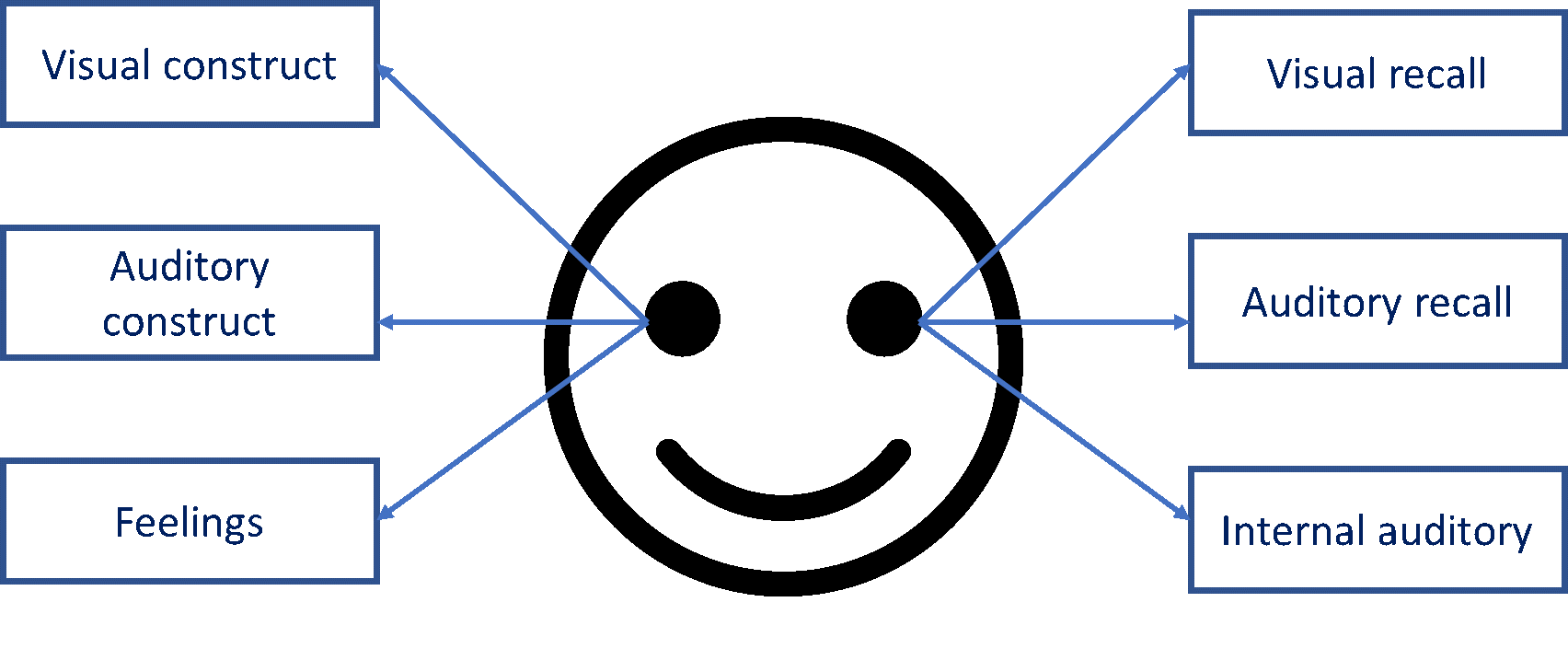
In the late seventies and early eighties researchers discovered that people move their eyes in a certain way when they think. Students were asked a series of questions and the researchers noticed that their eye movements, when thinking, followed a structured pattern. They realized that by looking at someone’s eyes, you could tell how they think, at least how they are thinking at the moment. Look at the above picture as if you were looking at someone to understand the directions of the eye movement.
Visual recall: This is when you are seeing images from the past. You are recalling them from memory because they are things that you have seen before. You are using this type of thinking when you answer questions like: what did your curtains look like when you were a teenager? What did your first car look like?
Visual construct: This is when you are visualizing something you have never seen before or you are making something up in your head: what would your car look like if it was painted a different color? What would you look like if you lost 30 kgs?
Auditory recall: When you remember sounds or voices that you have heard before or things that you have said to yourself before. Asking “what was the last thing I said to you?”, “Can you remember the sound of your dad’s voice?”
Auditory construct: Making up sounds you have never heard before. “What would I sound like if I were fluent in Spanish?” “What would I sound like if I spoke like Donald Duck?”
Kinaesthetic (feelings): when you are accessing your feelings, you tend to look in this direction. What does it feel like to touch sandpaper? What does it feel like to be happy?
Internal auditory: when you are having an internal dialogue and talking to yourself. What do you say to yourself when things go wrong? Can you hear your favourite piece of music in your mind?
This is one way that body language can help you to understand how to communicate with another person because the eyes are often the key to knowing what ‘wavelength’ the other person is on at that moment and through which form of communication they are likely to best understand what you have to say.