
Network analysis
A well-balanced team is a necessity for success in today’s increasingly competitive market. The Belbin Roles analysis helps you to understand specific roles needed for a successful team and subsequently fill the gaps or over subscriptions. However, another way to examine and monitor a team’s inter-communication is to perform a Network Analysis. Effectively, this lets you draw a Social Network where relationships between members are derived from the interaction among the members. Remember, a Social Network is a technical name and should not be confused with social networking sites such as Facebook, etc., though they are loosely related. A Social Network can be based on any type of human relationships. A family, for example, is a type of social network.
Network Analysis is the toolbox used to understand a social network. Network analysis has a rich history in many scientific fields such as sociology, anthropology, and communication studies. It is only in recent times that Network Analysis has been applied to organisations and has proved to be a powerful tool to diagnose team networking problems and help them to evolve and become more efficient. Using Network Analysis, the team can self-diagnose problems, design a target team, and measure its progress towards this target.
The best way to see how a network analysis works in practice is with an example such as the network shown below.
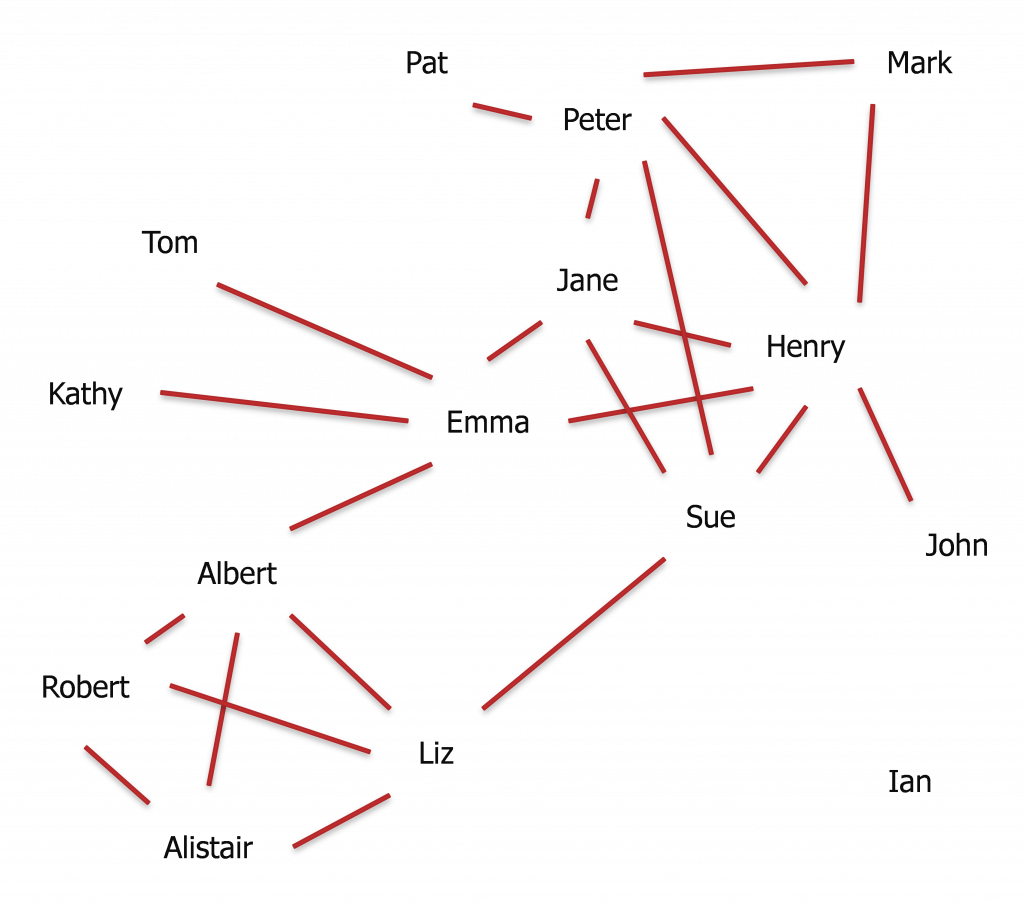
As you can see, several people are depicted in this image that have a ‘set’ of relationships with each other. The network is usually computer-generated based on the given relationships. The computer will automatically cluster those people who have more contacts together and spread out those who are not well connected to the group.
You may wonder what the lines represent. This can be set by you depending on your own analysis. For example, a line may represent the high frequency of communication between two people. Another example is if members have worked together before on a project.