
Leadership styles
Another way to look at a team’s life cycle is through its leadership. The Tannenbaum and Schmidt Continuum is a simple model which demonstrates the relationship between the level of freedom that a manager chooses to give to a team, and the level of authority used by that manager. As the team’s freedom is increased, the manager’s authority decreases. This is an ideal way for both teams and managers to develop over time.
Gradually a manager should aim to take the team from one end of the scale to the other at which point he should aim to have developed one or more potential successors from within the team to take over from him. Of course, this process can take time and the manager needs to be constantly aware of how the team is responding and developing.
The style continuum can be divided into four parts as shown below which is perhaps easier to remember as you progress from one stage to the next. The Style Continuum is as follows:
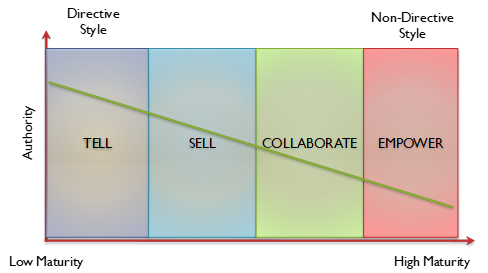
As you can see, as the team progresses towards maturity, the telling should be reduced, and team’s decision-making powers should increase. Effectively, in the telling stage the team is told what to do by the manager, in selling stage the manger attempts to convince the team of the direction and new ideas. In the collaborate stage the team and the leader work together to come up with solutions. Finally, in empower stage, the leader leaves the problem and the solution to the team to handle and only expects them to meet his targets since the team is now so mature that the leader should let go of direct control. The leader now is only responsible for the criteria and the vision and is more of a guidance than a controlling entity.