Johari Window
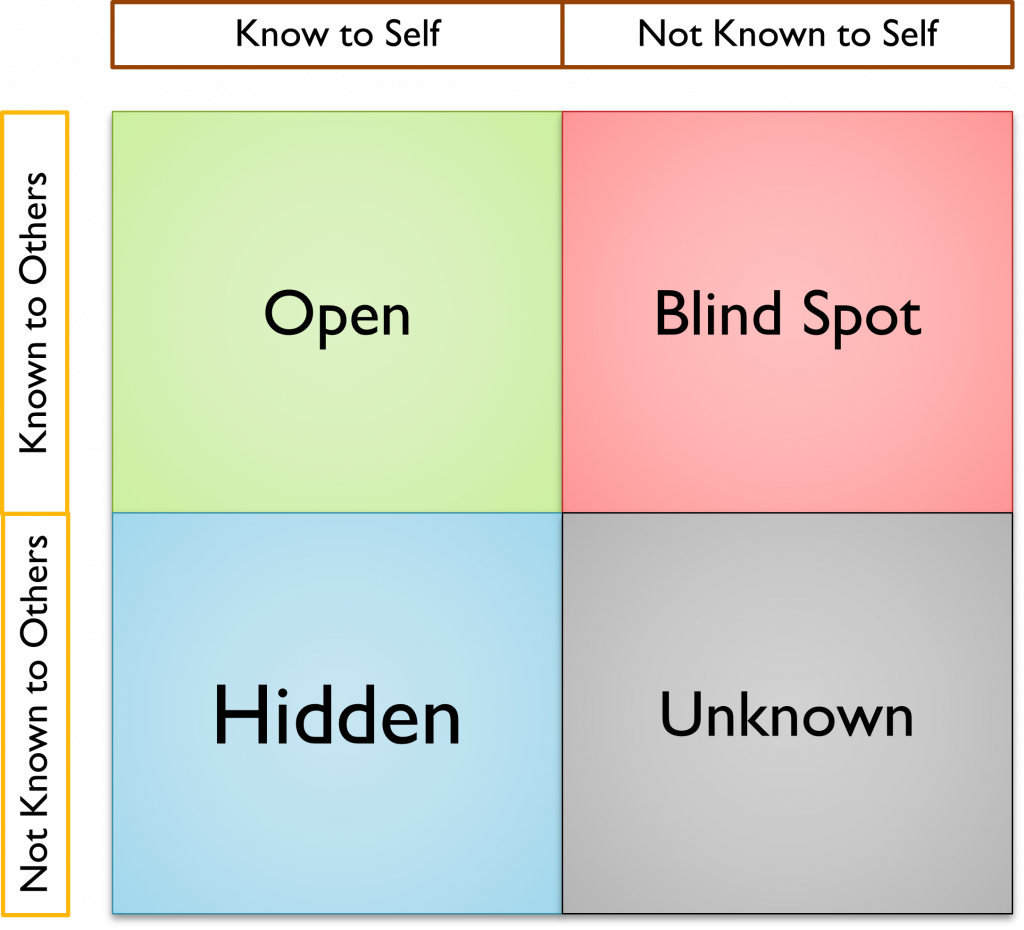
A concept created by Joseph Luft and Harry Ingham in 1950’s, Johari window is a psychological tool designed to understand interpersonal communications. The name Johari is the combination of the first names of the creators. The concept is especially useful in increasing common understanding between individuals within a group. Johari window is also known as an ‘Information Processing Tool’ as it represents information about people’s attitude, feelings, and intentions within the group. The window has four main areas each signifying an area of the individual’s personality which may or may not be known to them.
A typical Johari window is shown in the next page.
- The open area. This is a place for those qualities that you know you have and so do others.
- The blind spot. These are qualities that you are not aware of yourself, although others see them in you. Some of these qualities might be good which you need to pay attention to and use them in their full effect. If the qualities are negative, you need to adjust your behaviour to improve your image and reduce your ‘blind spot’ area.
- Hidden. These are qualities that you know you have, but others do not know them about you. There is a lot of potential for you, and you need go and sell these qualities to others. You need to make other team members aware of your positive skills so that your skills can be put to good use.
- Unknown. These are qualities that you or others are not aware of at all. Usually these are skills that you have not discovered yet. You simply do not know you can be good at them. It is typically due to lack of opportunity, awareness and the right environment or simply young age. Again, there can be a lot of potential here and you want to discover these qualities and expand your ‘open’ area.