
The Urgent/Important Matrix
Time management is about setting priorities and taking charge. It means changing habits or activities that cause us to waste time. It means being willing to experiment with different methods and ideas to enable us to find the best way to make maximum use of time. Putting in the right things, in the right order, with the right amount of time allocated is important.
The Time Management Matrix
A useful tool that can be used to prioritise work activities is the Time Management Matrix designed by Steven Covey (1994). The Urgent/Important Matrix is a powerful way of thinking about priorities. Using it will help you to overcome the natural tendency to focus on urgent activities, so that you can have enough time to focus on what is important.
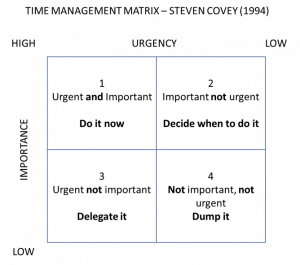
For you to understand the above quadrant you need to understand the meaning of important and urgent.
- Important activities have an outcome that leads to the achievement of your goals.
- Urgent activities demand immediate attention and are often associated with the achievement of someone else’s goals.
Quadrant 1: Urgent and important
Tasks that need to be done urgently. If they do not get done there will be a consequence e.g. critical emergency, crisis, last minute deadlines, lack of attention to things before they turn critical.
Quadrant 2: Not urgent but important
Tasks that you should be focusing on. They are important to you e.g. planning, preparation, learning, goals that you have set, key performance areas, things that you will be appraised on. If you do not give them attention, they will become urgent and important. If you look after tasks while they are important, they should not become urgent. Example: keeping up to date and learning is important. MS Office is constantly adding new functionalities to the software. If you keep up to date and know how to use your software, you could be saving time to produce documents or spreadsheets rather than trying to learn how to do it under stress.
Quadrant 3: Not urgent and not important
Tasks that are interruptions and distractions throughout the day that take your attention away from what is really important. It could be tasks that colleagues have asked you to do that is important for them and not for you. it could be email notifications popping up on your screen while you are working, meetings, interruptions.
Quadrant 4: Not urgent and not important
Tasks in this quadrant are tasks that are time wasting activities – they do not help you achieve goals, neither do they address important matters at hand e.g. playing games, paging through magazines, time wasters, surfing the internet without purpose
The most effective people spend their entire day in Quadrant 2 and ineffective people spend most of their day in Quadrants 1 and 3. Lazy people seem to spend their time in Quadrant 4 – playing Candy Crush, Solitaire etc.
The only way to have more time in Quadrant 2 is to stop doing things in Quadrants 3 and 4 (you can’t ignore the urgent important matters in Quadrant 1).
Exercise
Draw up a list of all the tasks you need to do. Once you have done that separate them into the quadrants as above giving them a number 1 (is it urgent), number 2 (is it important) or number 3 (is is something that is not important or for someone else). Carry out your tasks in that order – concentrate on getting rids of the 1’s, then work on the 2’s and if you have enough time, you can work on the number 3’s.
You will find that eventually your numbers 1 tasks will get less as you will be concentrating on most of them when they are important rather than urgent. You will also find that the number 3 tasks are often things that even if you don’t do them, they fall away.
Hopefully you have nothing in Quadrant 4! People who are doing things in Quadrant 4 are often those people who are spending too much time doing tasks in Quadrant 1 – always under stress and pressure to get things done. They go from being in a stressful environment to doing nothing but wasting time on unnecessary things instead of working at their goals.