
80/20 principles
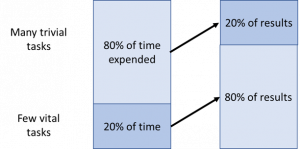 Also known as the Pareto Principle, this rule suggests that 20 percent of your activities will account for 80 percent of your results.
The “Pareto Principle” was named after the Italian economist Vilfredo Pareto, back in 1895. He noticed that people in society seemed to divide naturally into what he called the “vital few,” or the top 20 percent in terms of money and influence, and the “trivial many,” or the bottom 80 percent.
Later, he discovered that virtually all economic activity was subject to this principle, in that 80 percent of the wealth of Italy during that time was controlled by 20 percent of the population.
We can take Pareto’s 80 20 rule and apply it to almost any situation. Understanding the principle is essential to learning how to prioritize your tasks, days, weeks, and months.
How Does The Pareto Principle Work?
The Pareto Principle is a concept that suggests two out of ten items, on any general to-do list, will turn out to be worth more than the other eight items put together.
The sad fact is that most people procrastinate on the top 10 or 20 percent of items that are the most valuable and important, the “vital few,” and busy themselves instead with the least important 80 percent, the “trivial many,” that contribute very little to their success.
How To Apply The 80 20 Rule To Goal Setting
To effectively apply the 80/20 rule to setting SMART goals to boost your overall productivity take a piece of paper and write down ten goals. Then ask yourself: If you could only accomplish one of the goals on that list today, which one goal would have the greatest positive impact on your life?
Then pick the second most important goal. This way, you will have determined the most important 20 percent of your goals that will help you more than anything else. Continue to work at those goals that you have chosen as the most valuable all the time.
You often see people who appear to be busy all day long but seem to accomplish very little. The reason for this is that they are busy working on tasks that are of low value while they are procrastinating on the one or two activities that could make a real difference to their companies and to their careers.
The most valuable tasks you can do each day are often the hardest and most complex, but the payoff and rewards for completing them can be tremendous. Before you begin work, ask yourself, “Is this task in the top 20 percent of my activities or in the bottom 80 percent?”
The rule for this is: resist the temptation to clear up small things first
If you choose to start your day working on low-value tasks, you will soon develop the habit of always starting and working on low-value tasks.
If you often feel closed in by conflicting demands or overwhelmed by the number of tasks facing you, look for the 20% that will make the difference. As one of the 20% of successful, creative individuals, you will be producing valuable results and can reap the appropriate rewards. This puts you in control of your life, both for business and personal activities.